

Somewhere in your home there is probably a drawer of old phones, dead earbuds and tangled chargers. They look like junk, but electronic waste like this can hold small amounts of some of the most sought-after metals on Earth: the rare earth elements. These metals help make the powerful magnets inside electric car motors and wind turbines, and the glowing colours in screens and lamps.
Getting them back out of our waste is a chemical puzzle. A review published in November 2026 in the journal Applied Geochemistry by Young Gun Ko, of the Department of Chemical Engineering and Materials Science at Sangmyung University in Seoul, South Korea, explored an important question: how can we pick out specific rare earth metals from the messy liquid left after waste is dissolved, using materials that work like tiny, reusable “smart sponges”?
The answer is surprising. Rather than searching for one perfect material, the review argues the best route is a team of materials working in sequence, like runners in a relay.
Study at a glance
- What kind of study: a review. The author analysed and connected findings from hundreds of earlier studies rather than running a new experiment.
- Who and where: Young Gun Ko, Sangmyung University, Seoul. Published in Applied Geochemistry, volume 212 (2026).
- The question: how to recover rare earth elements selectively from “urban mining” waste using adsorbents, materials that grab metals onto their surface.
- The big idea: no single material can reliably pick out one rare earth from a real waste liquid. Combining several materials, each with different preferences, in a step-by-step process is the most practical path.
What are rare earth elements, and why do they matter?
Rare earth elements are a family of 17 metals: scandium, yttrium and the 15 “lanthanides” that run from lanthanum to lutetium on the periodic table. As the review explains, they are essential to modern technology. They are key ingredients in high-performance permanent magnets, used in electric vehicles and wind turbines. Others light up phosphors in displays and lamps, help refine petroleum, and appear in electronics and defence equipment.
As the world electrifies, demand is climbing, and supply is a worry. Ko describes how China holds a dominant position in the global rare earth supply chain, while the European Union has passed a Critical Raw Materials Act that sets targets for 2030 and names recycling as a pillar of future supply. Resource-poor, technology-heavy economies such as South Korea and Japan are especially exposed. The review’s point is that rare earth supply depends on policy as much as on geology, which makes recycling a strategic need, not just a green bonus.
Urban mining: treating waste as an ore
Traditional rare earth mining digs up minerals such as bastnäsite and monazite and processes them with large amounts of energy and chemicals, producing a lot of waste. Urban mining flips the idea: it recovers valuable metals from things we have already used and thrown away.
The review lists the main “urban ores”: electronic waste, spent permanent magnets, the glowing powders (phosphors) from old lamps, polishing slurries, and industrial leftovers such as coal fly ash. According to the studies Ko cites, some of these wastes contain rare earths at concentrations comparable to, or even higher than, certain natural ores.
The hard part: a needle in a chemical haystack
To recover the metals, waste is usually dissolved in acid. The result is a liquid called a leachate, and this is where the trouble starts. The review describes these leachates as typically very acidic (often below pH 2) and crowded with other metals. Iron and aluminium can be present at concentrations many times higher than the rare earths: in the review’s words, “orders of magnitude” higher. Spent magnet leachates are dominated by iron, e-waste brings copper, zinc, nickel and cobalt, and coal fly ash adds aluminium, calcium and silicon.
Then there is a second, deeper problem. The rare earths are near-identical twins. They almost all carry the same electrical charge, and their size shrinks only slightly from one element to the next, by about one-hundredth of an ångström. That is a tiny fraction of the width of a single atom. Each rare earth ion also wears a tight “coat” of water molecules that must be partly pulled off before a material can grip it firmly. Telling one rare earth from its neighbour is therefore one of the hardest separation jobs in chemistry.
Meet the “smart sponges”
Industry has long separated rare earths using solvent extraction, which shakes the metal solution with organic solvents over many stages. Ko notes that this works for pure products but needs large volumes of solvent, many steps, and struggles with dilute liquids like waste leachates.
The alternative the review focuses on is adsorption (with a “d”). Unlike a kitchen sponge that soaks liquid into itself, an adsorbent catches particles onto its surface. A good adsorbent for rare earths is simple to operate, works with dilute liquids, and can be cleaned and reused. The review breaks the design of these materials into three parts.
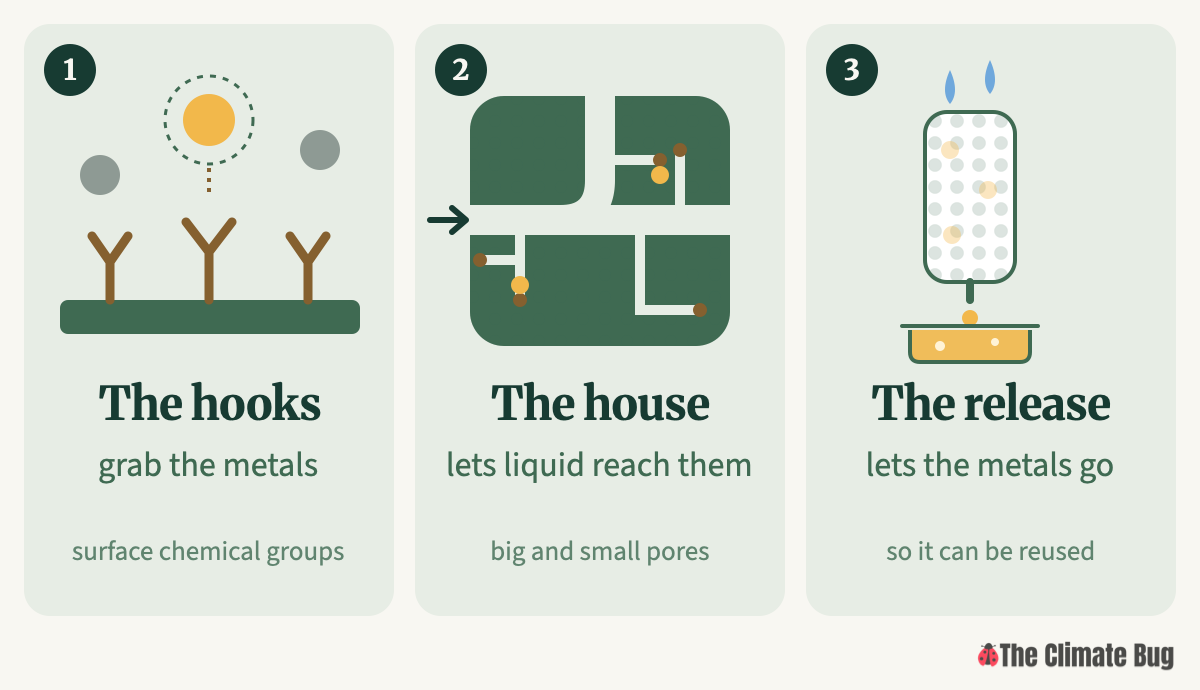
1. The hooks: what does the grabbing
The real selectivity comes from small chemical groups attached to the material’s surface, called functional groups. Rare earths prefer to bond with oxygen atoms, so the review identifies oxygen-rich groups, especially phosphonic acids and amidoximes, as the most reliable hooks.
But there is a Goldilocks rule. If a hook grips too tightly, the metal is hard to release, the material gets “clogged”, and it wears out sooner. Other groups play supporting roles. Sulfonic acid groups are fast but not choosy, so they work best as “funnels” that draw metals towards the selective hooks. Carboxyl and nitrogen-containing groups mostly act as helpers.
2. The house: the porous material holding the hooks
Hooks are only useful if metals can reach them. That is the job of the porous material underneath, which Ko calls an “active enabler” rather than a passive support. The best designs have a hierarchy of pores, like a city with highways and side streets. Large pores (wider than 50 nanometres) let liquid flow in quickly, while smaller pores pack in more hooks.
Each type of material has trade-offs. Polymer resins offer the best overall balance for real use. Silica can dissolve in strong acid. Metal-organic frameworks offer precise, custom-made pores but are often too fragile or costly for industry so far. Biochar and activated carbon are cheap and easy to scale up, but on their own they are not very choosy. The review sees them as low-cost first steps to concentrate metals, or as a base for attaching better hooks.
3. The release: getting the metals back out
Catching metals is only half the job. To be useful, the sponge must let them go as a concentrated, clean solution, and then be ready to use again. This step is called desorption. Ko stresses that it is not an afterthought: it decides how pure the product is, how long the material lasts and how much the whole process costs.
The main options are rinsing with acid, which works well for phosphonic and carboxyl hooks; using dissolved “chelating” chemicals that pull metals away, although some, such as EDTA, linger in the environment; and, a newer idea, using electricity to release metals from conductive materials with fewer added chemicals.
The big idea: a relay team, not a superhero
This is the heart of the review. Ko writes that developing an adsorbent selective for just one rare earth element is “practically impossible”. Instead, the review proposes passing the leachate through a series of columns, each packed with a different material that prefers a different group of rare earths.
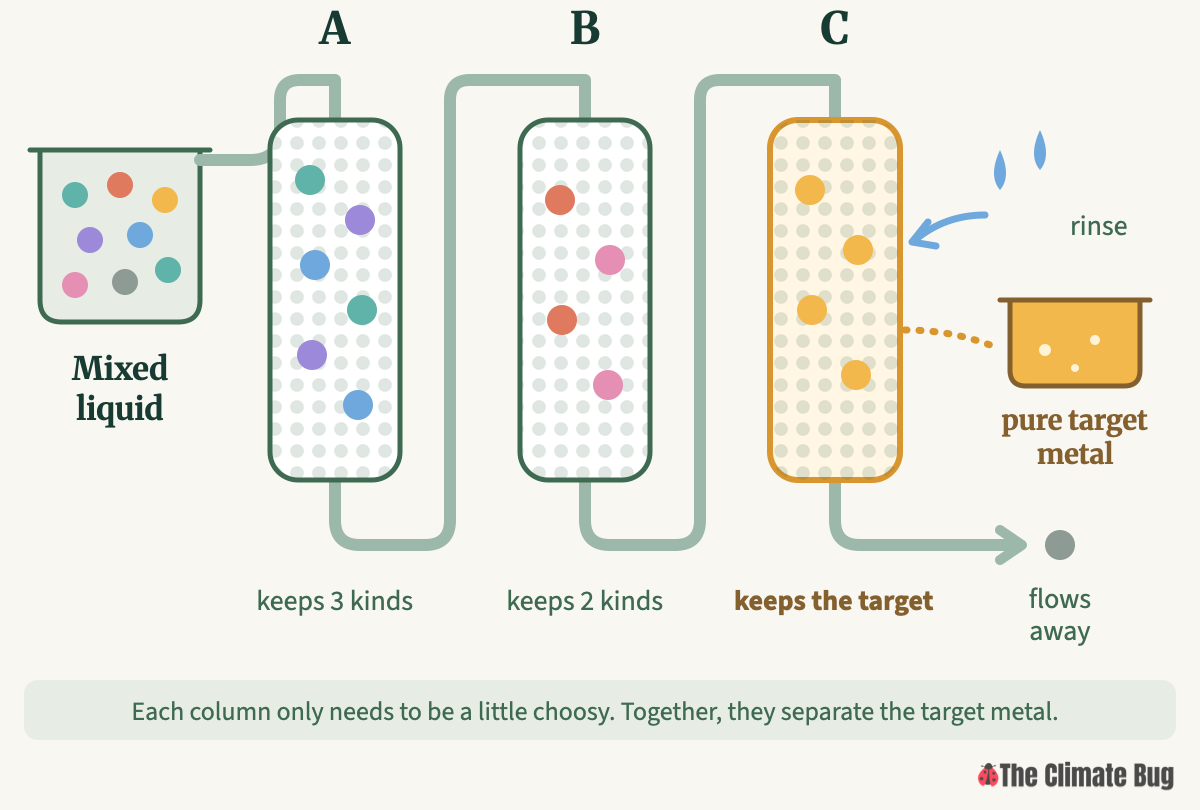
- The mixed liquid flows through column A, which holds on to some rare earths and lets the rest pass.
- What passes then flows through column B, which captures a different group.
- The remainder reaches column C, which keeps the target metal and lets the last one flow away.
- Finally, a rinse releases the target metal from column C in concentrated form.
Each material only needs to be moderately choosy. Stacked together, and with careful control of acidity during each rinse, those modest preferences add up to a clean separation. The review’s conclusion is that the most practical strategy is a combination of selective adsorbents with hierarchical pores, used in multi-stage adsorption and desorption.
What to keep in mind
- This is a review, not a new experiment. The relay process is a proposed design built from existing research, not a plant that has been built and tested.
- There is a lab-to-plant gap. Ko points out that most published studies tested simple mixtures of two or three metals at fairly high concentrations. Real waste liquids are far messier, and choosiness measured in the lab can drop sharply in them.
- Every material faces a three-way trade-off between how choosy it is, how much it can hold, and how easily it can be cleaned and reused.
- Cost and environmental impact still need testing. The review recommends judging materials by cost per kilogram of rare earth recovered, and carrying out life-cycle and cost analyses early in development.
Why it matters
The clean-energy transition runs on metals, and how we source them matters for both the environment and security of supply. This review offers a clear way of thinking about recycling rare earths: stop chasing a single miracle material, and design the hooks, the pores and the release step together as one system. If that approach makes it out of the lab, the old phones in our drawers could become a real source of the metals that power wind turbines and electric cars.
Original Research & Further Reading
Ko, Y. G. (2026). Selective separation and recovery of rare earth elements using adsorbents for urban mining: Design of functional groups, porous materials, and desorption strategies. Applied Geochemistry, 212, Article 107165. https://doi.org/10.1016/j.apgeochem.2026.107165