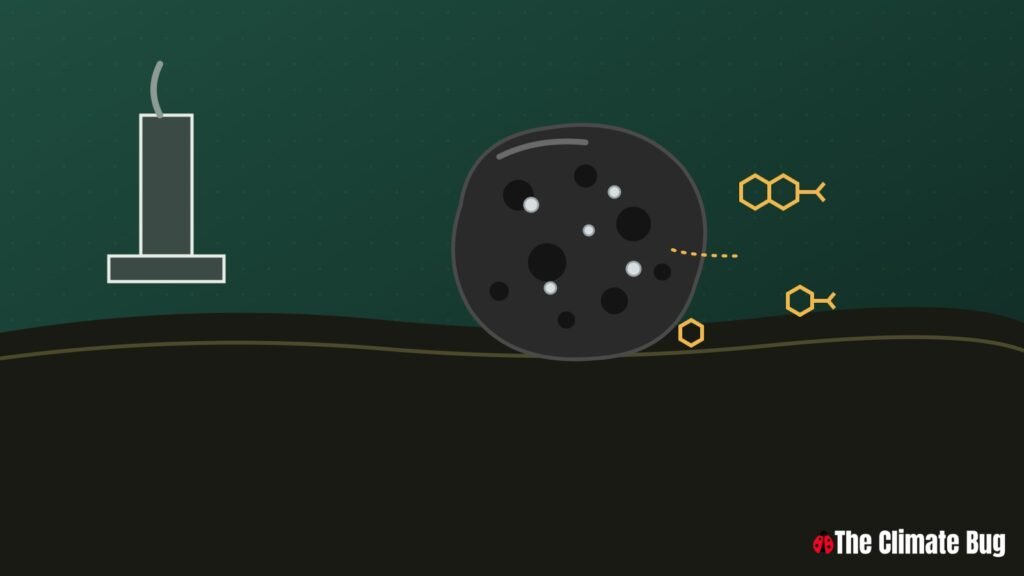

Extracting bitumen from Canada’s oil sands uses large volumes of water. What comes out, known as oil sands process-affected water (OSPW), is stored in tailings ponds because it contains organic compounds that are toxic to aquatic life. Among the most problematic are naphthenic acids, part of a group called acid-extractable organics (AEOs). Activated carbon can remove them, but treating water at that scale with activated carbon is costly.
A study published in Chemosphere in 2017 by Tazul Bhuiyan, Jin Kwon Tak, Sebastian Sessarego, Don Harfield and Josephine Hill asked whether biochar made from cheap plant waste could do the job, and which of its properties matter most.
Study at a glance
- Type: laboratory adsorption experiments using oil sands process-affected water
- Biochars: six, made from wheat straw, pulp mill sludge, switchgrass, mountain pine, hemp shives and aspen wood
- Source: Bhuiyan et al. (2017), Chemosphere 168, 1337–1344
What the researchers did
The team compared six biochars made from different kinds of biomass, measured how much of the acid-extractable organics each one adsorbed from OSPW, and looked for the biochar properties that best explained the differences. They considered the usual suspects in adsorption research, such as surface area, pore volume, polarity and aromaticity, as well as the biochars’ ash and metal content.
What they found
- Wheat straw biochar performed best. It had the highest ash content of the six (14%) and the highest adsorption capacity, 0.59 mg of AEOs per gram of biochar. It was followed by biochar from pulp mill sludge, switchgrass, mountain pine, hemp shives and, last, aspen wood.
- Surface area did not predict performance. Adsorption showed no obvious trend with surface area, total pore volume, polarity or aromaticity, properties often assumed to drive adsorption.
- Metal content did. The results were consistent with the acids in the water, in their charged carboxylate (naphthenate) form, binding to metals on the biochar surface, mainly aluminium and iron. That is why the paper’s title says “metal content matters”.
What to keep in mind
- Biochar is still much weaker than activated carbon. The authors report that the biochars’ capacity was roughly two orders of magnitude, about a hundred times, lower than that of a commercial activated carbon. Biochar’s case rests on cost, not performance.
- A cost argument, not yet a cost comparison. The authors suggest biochar may become competitive once results are normalised for cost, especially if environmental costs are included. That is a direction for future work rather than a result of this study.
- Laboratory scale. The experiments used real OSPW, which is a strength, but not a continuous treatment system.
Why it matters
The study challenges a common assumption in adsorbent design: that more surface area means better performance. For these pollutants, the chemistry of the surface, specifically the metals it carries, mattered more. Knowing which property counts gives researchers a clear target for improving biochar, for example by choosing metal-rich feedstocks or adding metals deliberately, which could narrow the gap with activated carbon.
Reference
Bhuiyan, T. I., Tak, J. K., Sessarego, S., Harfield, D., & Hill, J. M. (2017). Adsorption of acid-extractable organics from oil sands process-affected water onto biomass-based biochar: Metal content matters. Chemosphere, 168, 1337–1344. https://doi.org/10.1016/j.chemosphere.2016.11.126