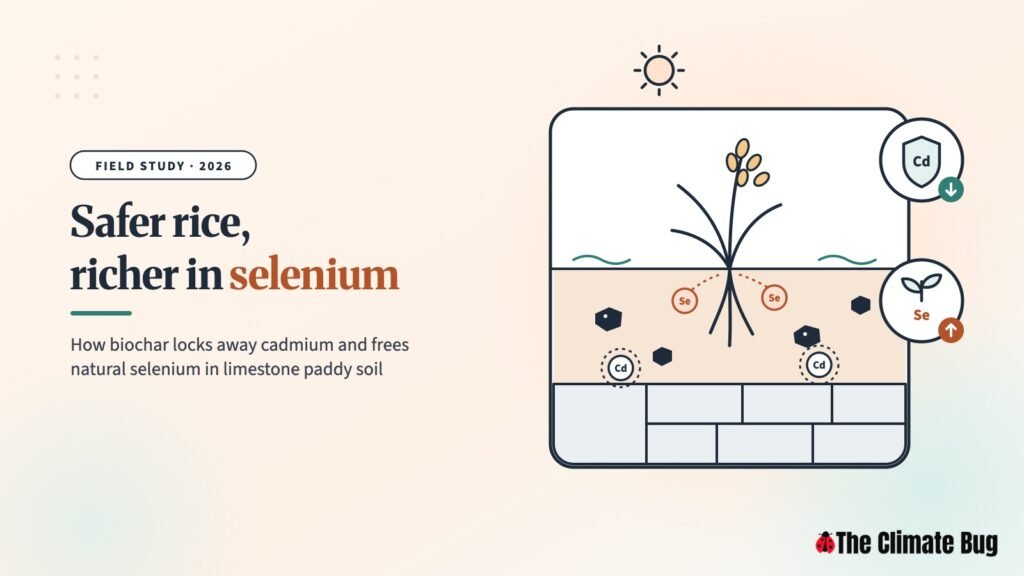

Imagine farming rice on land where the problem is not pollution from a factory or a mine, but the rock itself. In parts of southwest China, rice paddies sit on soils made from limestone. Over thousands of years, as rain slowly dissolved that rock, it left behind elements that do not wash away easily. Two of them matter a great deal for the people who eat the rice: cadmium, a toxic metal, and selenium, a nutrient our bodies need in small amounts.
That creates an odd double problem. The soil holds too much of the bad metal in a form rice can take up, and plenty of the good nutrient in a form rice struggles to reach. A 2026 field study in the journal Biochar, led by Pingfan Zhou, Yuanyuan Xu and Jing Guo with Caide Huang, Rong Su and Deyi Hou, from Tsinghua University and the Guangxi Zhuang Autonomous Region Ecological and Environmental Monitoring Centre, asked a simple question: can one soil treatment lock cadmium away and set selenium free at the same time?
Study at a glance
- Who: Zhou, Xu, Guo, Huang, Su and Hou (2026), Biochar (open access).
- Where: a real rice paddy in a karst (limestone) area of southwest China, where cadmium and selenium occur naturally.
- What they tested: three biochar mixes, one with clay, one with cow manure and one with iron powder, each at 5, 10 and 20 tonnes per hectare, across two rice seasons in 2023.
- Headline results: cadmium in rice grains fell by 42% to 85%, selenium rose by 92% to 358%, and yields rose by about 30% to 69% on average.
- Best choice: the iron mix worked fastest; the cheaper clay and manure mixes caught up in the second season.
Two elements, one rock
Cadmium is one of the biggest worries for food safety in rice-growing regions. The authors note that it is enriched in roughly 7% of soils in China and about 5.5% of farm soils in Europe. When cadmium comes from human activity, such as certain phosphate fertilisers or wastewater irrigation, you can cut it off at the source. When it comes from the rock under the field, there is no source to switch off.
Selenium is the other side of the story. It supports the immune system and thyroid hormones, and too little of it is linked to heart and muscle problems. The paper cites estimates that more than a billion people do not get enough selenium, a quiet form of malnutrition sometimes called “hidden hunger”. Selenium is also tricky: the gap between too little (under about 40 micrograms a day) and too much (over about 400) is unusually narrow.
At the study site, the soil was slightly acidic (pH 5.8). It held 0.51 mg of cadmium per kilogram, above China’s limit of 0.4 for rice paddies, and 5.61 mg of selenium per kilogram, which is naturally very high. In acidic soil, cadmium moves easily into plants, while selenium tends to stay stuck. The team saw an opportunity in that difference: if they could change the soil conditions, perhaps they could push the two elements in opposite directions.
Three recipes for the soil
Biochar is a charcoal-like material made by heating plant or animal waste with little oxygen. On its own it can hold metals, but the team blended it with other ingredients to create three distinct “recipes”, each designed to trap cadmium in a slightly different way:
- BC-Clay: corn cob biochar made at a low temperature (300 °C), mixed with a natural clay called palygorskite and quicklime. Both the biochar and the clay are rich in oxygen-containing groups that grip cadmium.
- BC-Manure: biochar made from cow manure at 700 °C, mixed with dried cow manure and quicklime. The idea was to trap cadmium by both binding and forming solid deposits.
- BC-ZVI: rice husk biochar made at 700 °C, mixed with zero-valent iron (fine metallic iron) and magnesium oxide. The team expected this to be the strongest, but also the most expensive.
All three mixes also raise soil pH, making it less acidic. As we will see, that turned out to be one of the most important parts of the story.
How the field trial worked
This was not a greenhouse pot test, but a real paddy in a region with heavy rain (about 1,790 mm a year) and a warm, subtropical climate. The field was divided into small plots of 4.5 by 2 metres, separated by raised soil ridges so water and soil could not mix between them. Each treatment was repeated in three plots, placed at random.
- 3 April 2023: the biochar mixes were worked into the top 20 cm of soil, at 5, 10 or 20 tonnes per hectare. This was the only time they were added.
- April to July: the first (early) rice crop, a local variety called Wanqianxiangzhan, was planted and harvested.
- July to October: a second (late) crop of the same variety was grown with no fresh biochar, so any change showed how the treatment aged in the soil.
- Measurements: the team measured cadmium and selenium in the rice grains, how much of each could be washed out of the soil by water (a sign of how “mobile” they were), crop yield, and soil properties such as pH and nutrients.
What they found
Less cadmium in every treated plot
Every treatment lowered cadmium in the rice grains: by 44% to 79% in the first crop and 42% to 85% in the second. The key test is China’s food-safety limit of 0.2 mg of cadmium per kilogram of rice. In the first season, only three treatments got the grain under that line: the clay mix at the highest dose, and the iron mix at 10 and 20 tonnes per hectare. By the second season, the clay and manure mixes at every dose had joined them, along with the iron mix at its two higher doses.
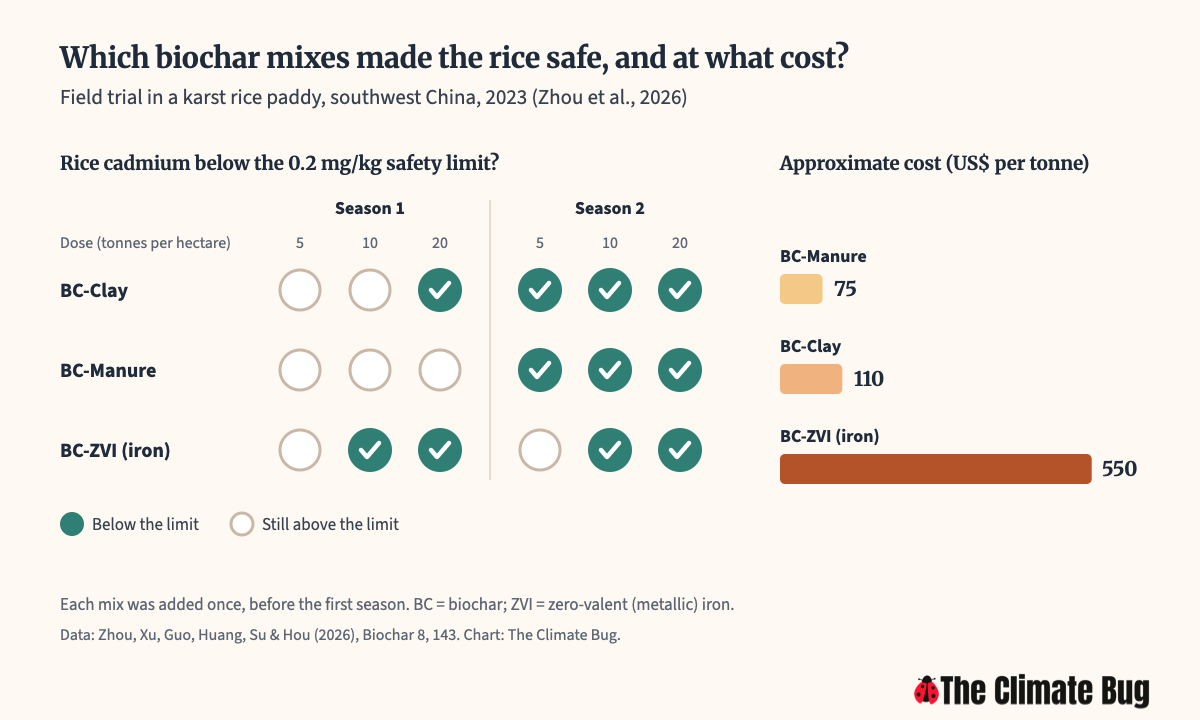
So the iron mix acted quickly, while the clay and manure mixes needed time. The authors suggest that iron grabs and co-precipitates cadmium almost at once, whereas the mineral and organic mixes have to weather in the soil before their binding sites become fully active.
More selenium, but not too much
At the same time, selenium in the grains went up in every treatment: by 94% to 211% in the first crop and 92% to 358% in the second. Importantly, none of the grains went above 0.30 mg per kilogram, the upper end of China’s recommended range for selenium-rich rice. In other words, the rice became richer in selenium without reaching levels that raise safety concerns. And this happened without adding any selenium fertiliser: the biochar simply released the selenium that was already in the soil.
A bigger harvest too
As a welcome bonus, the treated plots produced more rice, with average yield increases of about 30% to 69%. Biochar, clay and manure can all supply nutrients and support plant and root microbes.
More is not always better
One surprising finding was that adding more biochar did not always lock up more cadmium. For the manure mix, going from 5 to 10 tonnes per hectare actually nudged water-extractable cadmium up slightly. The authors think extra fresh manure may release dissolved organic matter that carries cadmium with it, and that binding sites may simply fill up. Selenium behaved more simply: a bigger dose always freed more of it.
Why the two elements moved in opposite directions
In the soil itself, water-extractable cadmium fell by 26% to 62%, while water-extractable selenium rose by 36% to 267%. The rock had delivered both elements together, yet the treatments pulled them apart. The researchers point to a few connected reasons:
- Soil pH went up. All treatments moved the soil from acidic towards neutral. At higher pH, cadmium tends to form solid compounds such as hydroxides, carbonates and phosphates, while selenium shifts towards forms that dissolve more easily.
- Opposite electric charges. Cadmium exists in soil as a positive ion, so soils with more “cation exchange capacity” hold on to it. Selenium exists as a negative ion, so it is not held the same way and can be pushed into solution.
- Phosphate plays both sides. More available phosphorus was linked to less cadmium and more selenium in the grain. Phosphate can form solids with cadmium, and it competes with selenium for the same spots on soil minerals.
- Inside the plant. Earlier research suggests selenium can reduce how much cadmium rice roots take up, so the extra selenium may have helped keep cadmium out of the grain too.
These are the authors’ best explanations based on correlations and earlier studies, not mechanisms they directly proved in this field.
Cost and choice
For farmers, price matters as much as performance. The authors estimate the manure mix at about 75 US dollars per tonne, the clay mix at about 110, and the iron mix at about 550. The clay and manure mixes also use widely available ingredients such as crop waste, natural clay and livestock manure, while the iron mix depends on industrial iron powder.
Their recommendation is practical: for moderately contaminated soils, use the clay or manure mix and apply it well before planting, so it has time to start working. Use the iron mix when safe rice is needed from the very first season, accepting the higher cost. They also note that the iron’s quick effect could fade as it is used up, so it may need topping up over time.
What to keep in mind
- One site, one year. The trial covered a single field and two growing seasons in 2023. The authors say the results may not transfer directly to karst soils with different rocks or different cadmium and selenium levels.
- Long-term effects unknown. Whether the treatments keep working, or wear out, over several years still needs to be tested.
- Costs are rough estimates. A full economic and life-cycle assessment, including transport and spreading, has not been done yet.
- Exact values are in the figures. Treatment-by-treatment numbers appear in the paper’s charts and supplement. We have only quoted values stated in the text.
Why it matters
Rice is a daily staple for billions of people, and in some regions the soil itself makes it harder to grow safely. This study shows that a one-off application of a fairly simple biochar mix can turn a problem field into one that produces rice that is lower in a toxic metal, richer in a vital nutrient, and more plentiful, all using what the land already holds. It is a hopeful example of working with geology rather than against it, and a reminder that the best soil solutions often fix more than one problem at once.
Original Research & Further Reading
Zhou, P., Xu, Y., Guo, J., Huang, C., Su, R., & Hou, D. (2026). Field application of biochar-based amendments for safe crop production in karst paddy with a high geological background: Unraveling Cd-Se dynamics. Biochar, 8, Article 143. https://doi.org/10.1007/s42773-026-00657-1