

Longyan, in China’s Fujian province, is home to rare earth mining. Mining leaves behind wastewater that still carries traces of the valuable metals people went to so much trouble to dig up. Letting that water run off wastes those metals, and as the researchers point out, long-term exposure to rare earths has been linked to health concerns. So the obvious question is: can we catch the metals before the water leaves the site?
The hard part is being picky. Mining wastewater is a mix of many dissolved metals, and most materials that grab rare earths also grab everything else. A 2025 study in Separation and Purification Technology, led by Yalin Yang and Zuliang Chen at Fujian Normal University with colleagues from Longyan Rare Earth Development Co. and the University of South Australia, set out to build a “metal catcher” that goes after rare earths while leaving common metals like zinc behind.
Study at a glance
- Who: Yang, Liu, Weng, Chen, Owens and Chen (2025), Separation and Purification Technology.
- Material: tiny iron particles made with a plant extract and spread across biochar, called BC-FeNPs for short.
- Tested on: real wastewater from a rare earth mining site in Longyan, China, not a clean laboratory solution.
- Headline result: the material captured up to 88% of the rare earth lutetium, but under 9% of zinc. It held on to rare earths roughly 40 to 80 times more strongly than zinc.
- Recovery: mild acetic acid (the acid in vinegar) washed out more than 85% of the captured rare earths.
The idea: iron particles on a biochar raft
Iron nanoparticles, particles more than a thousand times thinner than a human hair, are already known to grab rare earths because of their huge surface area. But they have a frustrating habit: they clump together, which wastes most of that surface. They are also mechanically weak and break down in acid.
The team’s solution was to give the particles something to hold on to. They grew the iron particles on biochar, a porous, charcoal-like material, so the particles stay spread out instead of clumping. Instead of harsh chemicals, they made the particles using an extract from Euphorbia cochinchinensis, a plant whose natural compounds turn dissolved iron into nanoparticles. Earlier research had shown that iron particles made this way can pick rare earths out of mining wastewater; this study tested whether adding biochar makes them better.
The plant extract does a second job. It leaves a thin coating on the particles, rich in oxygen- and nitrogen-containing chemical groups, which turn out to be the “hooks” that grab the rare earths.
How the experiment worked
The researchers collected wastewater from a working rare earth mining site in Longyan and filtered it to remove particles and microbes. They then compared three materials side by side: plain biochar, the iron particles on their own, and the combined biochar–iron material.
- Capture: 100 mg of each material was shaken in 100 mL of the mine water at 30 °C, the local outdoor temperature, and pH 5.8, the water’s natural acidity. Samples were taken over four hours.
- Release: the loaded material was then shaken in dilute acetic acid for two hours to wash the metals back out.
- Reuse: the capture-and-release cycle was repeated five times.
- Looking closely: the team examined the particles under electron microscopes, measured their surface charge, and used infrared and X-ray techniques to see which chemical groups were doing the grabbing.
They followed five rare earths, chosen for their importance: neodymium, europium, terbium, dysprosium and lutetium. Zinc was tracked as an example of an unwanted “ordinary” metal.
What they found
Smaller, better-spread particles
Under the microscope, the iron particles made on their own formed irregular clumps, with particles averaging 84 nanometres. On biochar, they were spread out and smaller, averaging 39 nanometres. After soaking in mine water the particles grew to about 67 nanometres as metals built up on their surface, then shrank back to about 49 nanometres once the metals were washed off.
The combination beat both of its parts
For lutetium, the best-captured rare earth, the biochar–iron material removed 88.4% from the mine water once it reached equilibrium, after about two hours. The iron particles alone removed about 82%, and plain biochar removed less than 10%. Strikingly, the combined material did slightly better even though it contained about a quarter less iron, because the iron was no longer wasted in clumps.
Picky about rare earths, not zinc
Zinc barely stuck: only 8.7% was captured. To compare how strongly the material held each metal, the researchers used a measure called the distribution coefficient, where a higher number means a stronger grip. The rare earths scored between 918 and 1,898, while zinc scored just 23.9.
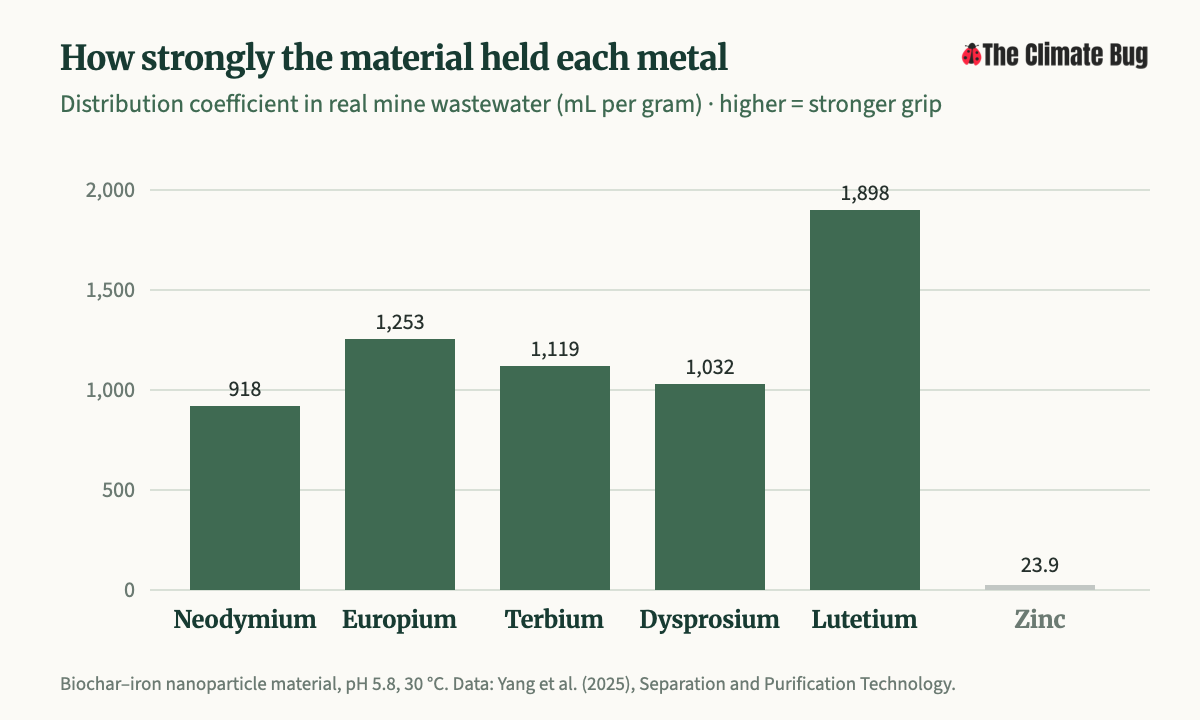
Close-up analysis of the surface after soaking told the same story. Neodymium made up nearly 11% of the surface and dysprosium 7.5%, while zinc was only 0.4%.
Why it is so picky
The researchers pieced together three reasons:
- Electric charge. At the water’s pH, the material’s surface is negatively charged. Rare earth ions carry three positive charges, while zinc carries two, so rare earths are pulled in more strongly.
- Chemical hooks. Oxygen-rich groups from the biochar and the plant coating, plus nitrogen groups from the plant extract, bonded with the rare earths. The infrared and X-ray measurements showed these groups shifting once the metals attached.
- Swapping places. Rare earth ions traded places with hydrogen ions on the surface, a process called ion exchange.
The X-ray measurements also showed that the rare earths were not chemically changed when they attached. They were simply held, which is what you want if you plan to get them back out.
Getting the metals back
Catching metals is only useful if you can release them again. A weak acetic acid solution washed out more than 85.5% of every rare earth within two hours, compared with 47.5% of zinc. The acid floods the surface with hydrogen ions, which push the rare earths off their hooks. Acetic acid was chosen because it is a low-toxicity, environmentally friendlier option.
After five rounds
After five capture-and-release cycles, the material still captured about half as much rare earth as it did the first time, compared with 4.4% for zinc. Release stayed above 95% in every cycle. The authors describe this as excellent reuse stability.
What to keep in mind
- Real water, small scale. Using real mine wastewater is a big strength, but the tests were small flask experiments, not a treatment plant.
- Capacity drops with reuse. Losing about half of the capture ability over five cycles means the material would need replacing or regenerating in practice.
- Zinc as the only competitor tracked. The study reports selectivity against zinc; how the material handles other metals in the water is not described in the main paper.
- Some details are in the supplement. The recipe for the material and the full makeup of the wastewater are in the paper’s supporting information, which we did not review.
- Small number differences. A few figures differ slightly between the paper’s summary and its results section; we have used the results section.
Why it matters
Mines that recover rare earths from their own wastewater could protect nearby rivers and soils while getting more value from every tonne of ore. This study shows how a few simple ingredients (a plant extract, iron and biochar) can be combined into something that is not just a sponge, but a picky one. There is a long road from a laboratory flask to a working treatment system, but the idea of a cheap, plant-made material that catches rare earths and lets common metals pass is a promising one.
Original Research & Further Reading
Yang, Y., Liu, W., Weng, X., Chen, Z., Owens, G., & Chen, Z. (2025). Highly selective recovery of rare earth elements from mining wastewater using phyto-synthesized biochar dispersed iron nanoparticles. Separation and Purification Technology, 353, Article 128491. https://doi.org/10.1016/j.seppur.2024.128491