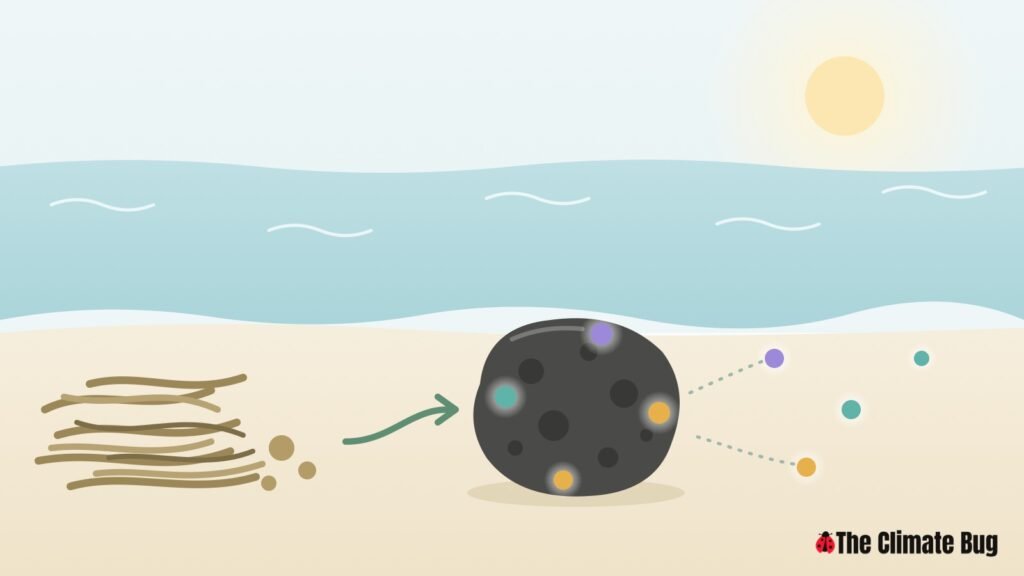

Along the coasts of Sicily, the sea leaves behind something most beachgoers simply step over: thick, brown drifts of dead leaves from Posidonia oceanica, a seagrass found only in the Mediterranean. Each year these underwater meadows shed huge amounts of old leaves, and the waves pile a good share of them onto the shore. To most people it is beach litter. To a team of Italian chemists, it turned out to be the starting point for something far more interesting: a material that can pull rare earth metals out of water.
Their study, led by Alberto Pettignano at the University of Palermo with colleagues at the University of Messina and the CNR-ITAE institute in Messina, was published in the Journal of Rare Earths in 2025. It asks a simple question with big implications: can biochar made from this beached seagrass help recover the rare earth elements our technology depends on?
Study at a glance
- Who: Muratore, Lascari and colleagues (2025), universities of Palermo and Messina and CNR-ITAE, Italy. Published in the Journal of Rare Earths.
- Material: biochar from dead Posidonia oceanica leaves, a by-product of turning the leaves into biofuel, tested plain and after two chemical “activation” treatments.
- Metals tested: lanthanum, neodymium and dysprosium, three rare earths used in electronics and magnets.
- Headline result: biochar treated with phosphoric acid captured about three to four times more of each metal than the untreated biochar.
- The catch: its capacity dropped by about 80% after the first reuse.
Why rare earths, and why from waste?
Rare earth elements are a family of 17 metals found inside computers, phones, lasers, medical equipment, electric car batteries and the permanent magnets in wind turbines. Despite the name, they are not truly rare; the problem is that they are spread thinly through the Earth’s crust. Mining them takes large amounts of chemicals, and the ores often contain radioactive elements such as thorium and uranium that must be handled carefully.
Supply is also concentrated. The authors cite US Geological Survey estimates that China produced around 240,000 of the world’s roughly 350,000 tonnes of mined rare earths in 2023. That imbalance is one reason the European Union lists rare earths as critical raw materials.
Old electronics offer another source. According to the studies the authors review, electronic waste can hold higher concentrations of valuable rare earths, such as neodymium and dysprosium, than mined ores, without the radioactive baggage. Recovering them usually means dissolving the waste in acid and then fishing the rare earths back out of the liquid. That second step is where a good “metal catcher” is needed.
From beach waste to biochar
The researchers point out that every hectare of Posidonia meadow produces roughly 10–20 tonnes of dead fragments at the end of its growing season, and about a quarter of that washes up on the shore. Because the leaves are free and plentiful on the Sicilian coast, they are attractive for making local biofuel by pyrolysis, which means heating the material with very little oxygen. Biochar, a porous, carbon-rich solid, is what is left over.
The team compared three versions:
- Plain biochar, straight from pyrolysis.
- Biochar activated with potassium hydroxide, an alkali.
- Biochar activated with phosphoric acid: dried leaves soaked in phosphoric acid at 85 °C for six hours, then heated to about 475 °C for an hour without oxygen.
What activation does to the material
Both treatments transformed the biochar. The plain version had a surface area of under 5 square metres per gram. After activation, that rose to about 324 m²/g with phosphoric acid and about 651 m²/g with potassium hydroxide. Both treated versions were also much richer in carbon, at around 86–87%, compared with about 50%.
Surface area alone, however, did not decide the winner. Under the electron microscope, the acid-treated biochar looked like a rough, sponge-like solid full of cavities. More importantly, it contained phosphorus. Infrared measurements showed phosphate groups on its surface, and those signals shifted clearly once rare earth metals were added. In other words, the metals were latching on to them.
There is also a question of electrical charge. At the slightly acidic conditions used in the tests (pH 5), the acid-treated biochar’s surface carries a negative charge, which attracts the positively charged rare earth ions. The other two biochars carry a positive charge at that pH, which works against them.
How much metal did it catch?
In tests at room temperature and pH 5, the phosphoric-acid biochar was the clear winner for all three metals. The potassium hydroxide version came second, roughly doubling the plain biochar’s performance, and the plain biochar came last.
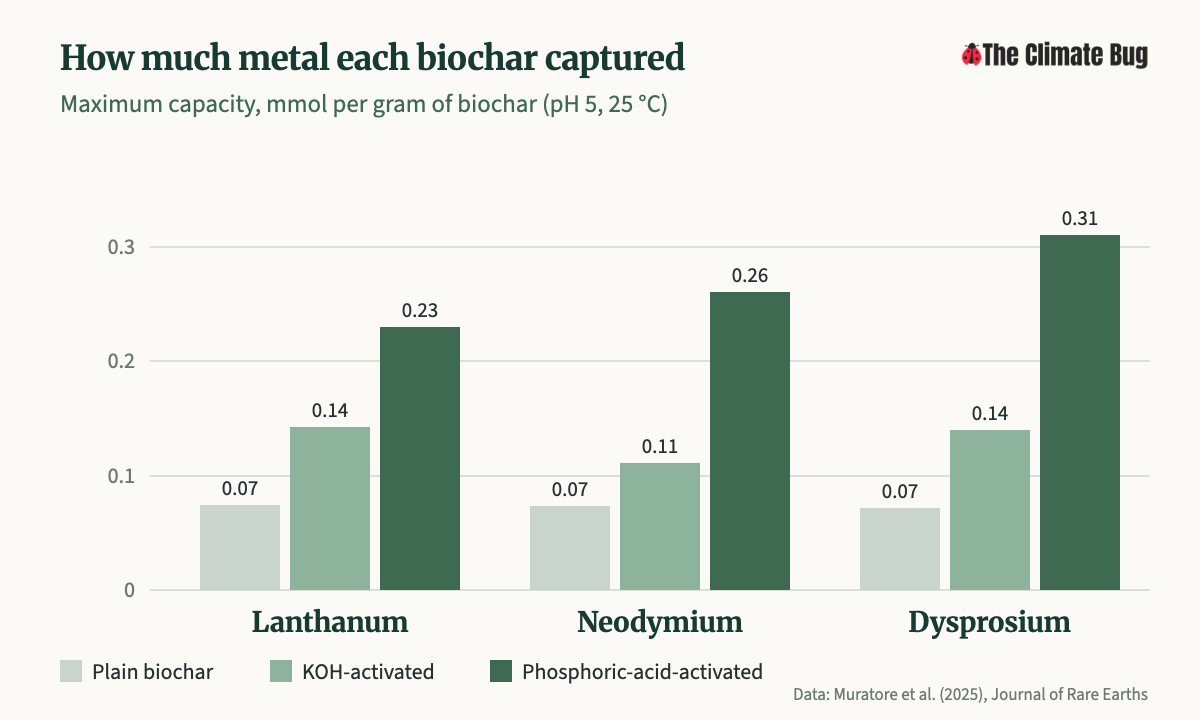
The best biochar’s maximum capacity was 0.23 mmol per gram for lanthanum, 0.26 for neodymium and 0.31 for dysprosium. By our conversion, that is roughly 32, 38 and 50 milligrams of metal per gram of biochar. As far as the authors know, it is the best-performing biochar reported so far for these three metals, although a few activated carbons do better.
One detail tells you something about how it works: the smaller the metal ion, the better it was captured (dysprosium > neodymium > lanthanum). The authors see this as consistent with strong binding between these metal ions and the phosphate groups in the biochar.
Most of the metal was captured quickly. The uptake followed two stages, a fast one and a slow one, with the larger share happening in the fast stage.
Real-world conditions make it harder
Real waste liquids are never just water and rare earths. When the team added sodium nitrate salt to mimic a busier solution, the biochar captured noticeably less, because the far more abundant sodium ions compete for the same binding spots. Making the solution more acidic also hurt: at pH 3, about a third less metal was captured, as hydrogen ions competed too. At pH 6, results were about the same as at pH 5.
Can it be reused?
This is where the authors are refreshingly honest. They packed the best biochar into a small column, loaded it with metal, washed the metal out, and repeated the cycle four times. Dilute nitric acid released all the captured metal each time. But after the first round, the biochar’s capacity dropped by about 80% with both washing solutions they tried, suggesting its structure changes after first contact with the metals. As the authors put it, the recyclability results were not excellent.
Their counterpoint is that the material is a by-product of biofuel production, essentially free, and in line with the idea of a circular economy, where one process’s waste becomes another’s resource.
What to keep in mind
- Laboratory scale. The tests used small amounts of biochar and clean solutions of one metal at a time, not real dissolved e-waste.
- One use, mostly. The large drop after the first cycle means this biochar currently works best as a single-use material.
- Not yet separating metals from each other. The study measured how much of each metal the biochar could hold, one at a time; separating mixed rare earths is a harder, separate challenge.
- Scaling up raises new questions. Collecting large amounts of beached seagrass would need to be done with care for the coastline, and that is outside the scope of this study.
Why it matters
It is easy to picture rare earth recovery as a story of big factories and complex chemistry. This study is a reminder that some of the tools might come from somewhere much humbler: a pile of dead seagrass on a Mediterranean beach. Turning a leftover from biofuel production into a material that grabs neodymium and dysprosium is not a finished solution, but it is a clever step towards treating both our waste and our electronics as resources.
Original Research & Further Reading
Muratore, N., Lascari, D., Cataldo, S., Raccuia, S. G. M., Lando, G., Lo Meo, P., Chiodo, V., Maisano, S., Urbani, F., & Pettignano, A. (2025). Recovery of rare earth elements by adsorption on biochar of dead Posidonia oceanica leaves. Journal of Rare Earths, 43(11), 2551–2561. https://doi.org/10.1016/j.jre.2024.11.010