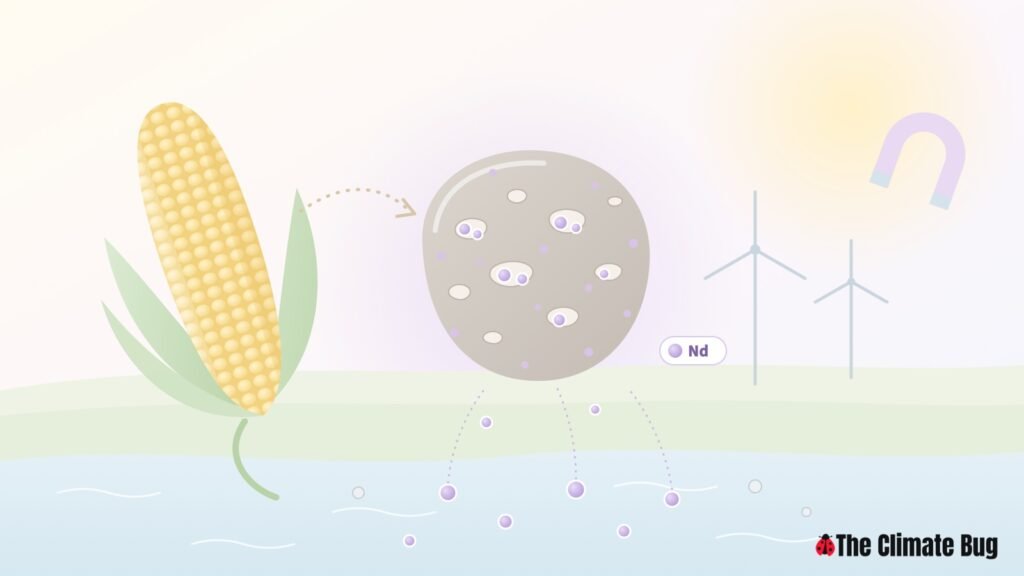

Every corn harvest leaves a mountain of cobs behind. The researchers behind this study put the figure at about 55 million tonnes of cobs in 2022, and in many places they are simply thrown away or burned. Meanwhile, in the rare earth mining areas of southern China, water draining from the mines carries small amounts of neodymium, the metal inside the powerful magnets of electric motors, wind turbines and headphones. Once that water flows away, the metal is lost.
So here is a nice puzzle: could one waste help rescue another? A 2025 study in the Journal of Water Process Engineering by Yang Wen, Lin Huang, Jinyang Yan and Bo Feng of Jiangxi University of Science and Technology in Ganzhou, a city at the heart of China’s rare earth industry, set out to answer it. They turned corn cobs into a charcoal-like “sponge”, gave it a coating of manganese oxide, and tested whether it could catch neodymium from water, including real liquid from a rare earth mine.
Study at a glance
- Who: Wen, Huang, Yan and Feng (2025), Journal of Water Process Engineering.
- Material: biochar made from corn cobs, then treated with potassium permanganate (KMnO4) so that manganese oxide sticks to its surface. The team calls it MBC.
- Target: neodymium (Nd), a rare earth metal used in permanent magnets.
- Headline results: about 12 times more surface area than plain corn cob biochar, best performance at pH 6, and 97% of neodymium removed in a single-metal test.
- Real-world test: in leachate from a rare earth mining area in Ganzhou, the paper reports that more than 60% of the neodymium was recovered.
- Reuse: after five rounds of washing with dilute hydrochloric acid, the material still worked at about 75% of its first-round level.
Why neodymium is worth chasing
Neodymium is one of 17 rare earth elements. As the authors explain, it is used in permanent magnets, electric motors and generators, as well as in lasers, fibre-optic communication, catalysts and coloured glass. Demand keeps rising, but natural reserves are limited. That makes every gram that escapes in waste water a small loss, both for the economy and for the environment around mines.
One of the simplest ways to pull a metal out of water is adsorption: you add a solid material whose surface grabs the metal, then lift the solid out. Activated carbon, zeolites and polymer resins are all used this way, but the authors point out their weak spots. Activated carbon can be costly and not very choosy, some zeolites struggle when other metals are present, and some polymers may break down as conditions change. The team wanted something cheaper, greener and pickier.
From corn cob to metal catcher
Biochar is what you get when you heat plant material with very little oxygen. Instead of burning to ash, it turns into a light, porous, carbon-rich solid, a bit like charcoal. Plain biochar can hold some metals, but this team wanted to give it extra “hooks”.
Their recipe, step by step:
- Prepare the cobs. Corn cobs from a farming area in Enshi, China, were chopped, washed, dried at 50 °C for a day, ground and sieved into a fine powder.
- Bake them into biochar. The powder was heated to 600 °C under nitrogen gas and held there for two hours. After cooling and rinsing, this plain biochar was called BC.
- Add the manganese coating. The biochar was stirred in a potassium permanganate solution at 80 °C for six hours, then washed and dried. Potassium permanganate is a strong purple oxidiser; here it leaves manganese oxide anchored to the biochar. This treated material is MBC.
The order matters. Many earlier methods add the chemical first and bake afterwards. Here the team baked first and coated second, so the pores formed during baking stay open and the manganese can spread evenly across them, rather than clogging the structure before it has formed.
A look under the microscope
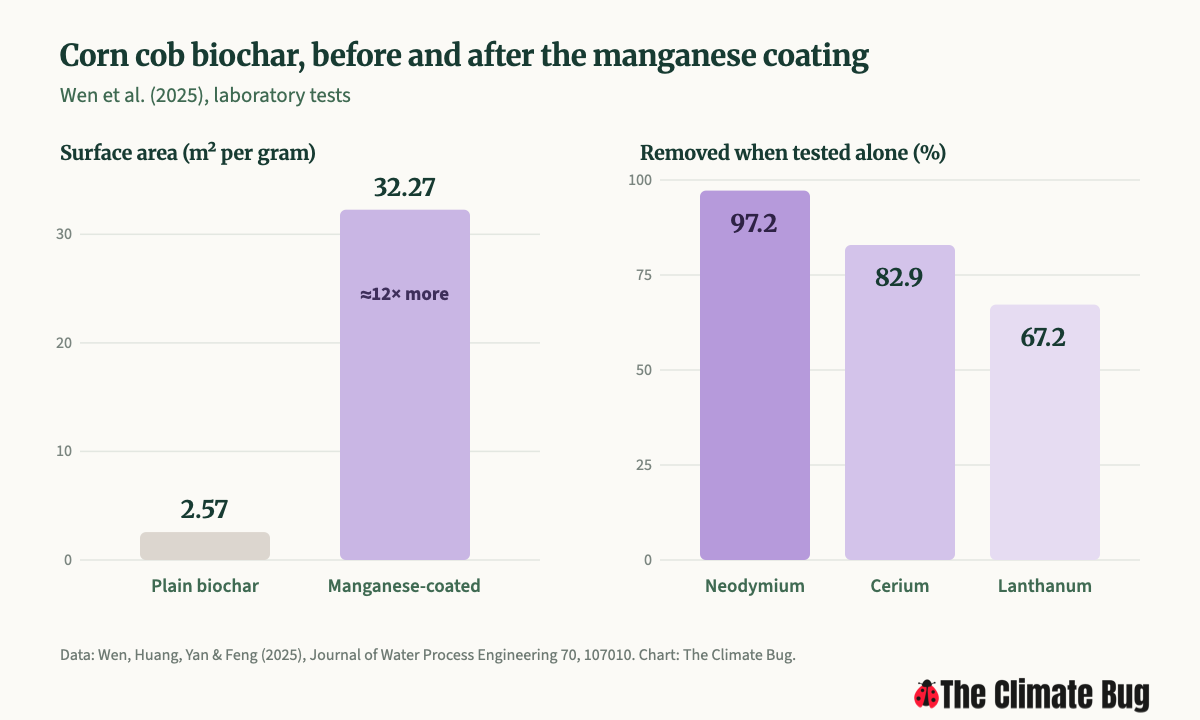
Under an electron microscope, the plain biochar looked rough, with very few visible pores. The manganese-treated version looked quite different: finer particles and many more openings on its surface. Gas measurements put numbers on this. The surface area jumped from about 2.6 to 32.3 square metres per gram, roughly 12 times more, and the total pore space grew about six-fold. The average pore became narrower (from about 15 to 8 nanometres), which the authors link to new, smaller pores forming.
Chemical tests confirmed the makeover worked. Manganese appeared on the treated biochar, its oxygen content rose, and infrared measurements showed more oxygen-containing groups (hydroxyl and carboxyl groups) plus a signal from manganese–oxygen bonds. These oxygen groups are the hooks that neodymium can latch on to.
How the experiments worked
The basic test was simple. The team put a small amount of biochar into 50 mL of neodymium solution in a flask, shook it at 25 °C for two hours, filtered it, and measured how much neodymium was left in the water. By changing one thing at a time, they worked out the best conditions.
How much material, and for how long?
With water containing 50 mg of neodymium per litre, adding more MBC helped up to 40 mg. Beyond that, extra material barely made a difference, so 40 mg was chosen to avoid waste. The capture was fast: close to 70% of the neodymium was removed in the first 10 minutes, while the surface was still full of free spots. After that it slowed down as the metal had to travel deeper into the pores, and it levelled off at about 120 minutes.
The acidity sweet spot
Acidity turned out to be crucial. The team tested pH 2 to 7 (above that, neodymium starts to form solids on its own). At pH 2, capture was at its worst: the water is crowded with hydrogen ions, which occupy the hooks and push neodymium away. As the water became less acidic, MBC held more and more neodymium, reaching 54.4 mg per gram at pH 5. The best overall performance came at pH 6.
How much can it hold?
Scientists use mathematical models to describe how a material fills up. Two of them matter here. The way MBC took up neodymium over time fitted a model that points to chemical bonding rather than loose sticking, and the way it filled up fitted the Langmuir model, which pictures metal ions settling into a single layer on the surface, one ion per spot. The paper’s summary gives a maximum capacity of 61.54 mg of neodymium per gram of MBC. Its isotherm table gives a higher theoretical ceiling of 88.63 mg per gram, so the true figure depends on which number you take; we explain this in the notes below.
How the biochar grabs neodymium
To find out what actually happens on the surface, the team compared the material before and after use with X-ray and infrared measurements. They saw new signals showing neodymium bonded to oxygen, including oxygen linked to carbon and to manganese. The oxygen-rich hydroxyl and carboxyl groups shifted after the metal arrived, a typical sign that they were holding on to it.
Putting the evidence together, the authors describe one main process and three helpers:
- Complexation (the main one): neodymium forms bonds with oxygen-containing groups on the surface, like a hand gripping a handle.
- Ion exchange: natural minerals in the biochar such as potassium, calcium and magnesium dropped after use, suggesting some of them swapped places with neodymium.
- Electrical attraction: at the right pH, the surface pulls in positively charged neodymium ions.
- Physical trapping: some neodymium simply settles into the pores.
Interestingly, the amount of manganese on the surface did not fall after use, so the authors conclude that swapping manganese for neodymium is not the main thing going on. The manganese seems to help mainly by creating more oxygen hooks and more pores.
Getting the metal back, and using the sponge again
Catching a metal is only half the job; you also need to get it back out. The team tried three washing liquids: dilute hydrochloric acid, ethanol and calcium chloride. Hydrochloric acid worked best, because its flood of hydrogen ions pushes neodymium off its hooks. Calcium chloride was the weakest, because calcium is not strong enough to compete for the spots.
After five cycles of catching and washing with the acid, MBC still worked at about 75.5% of its first-round level, a drop of 16.6 percentage points. The authors blame two things: a little neodymium left behind after each wash, and gradual wear on the pores and oxygen groups. Still, a material that can be reused several times means less replacement, lower cost and less waste.
Can it pick neodymium out of a crowd?
Real mine water is never pure. It contains many other metals that compete for the same hooks. So the team added aluminium and magnesium to the test water. Both reduced the capture, and aluminium was the bigger problem: at the highest level tested, neodymium removal fell from 97.18% to just 31.64%. Aluminium ions are similar in size and charge to neodymium, so they compete very effectively for the same spots.
Among rare earths, MBC showed a clear preference. Tested one at a time, it removed 97.2% of neodymium, 82.9% of cerium and 67.2% of lanthanum. When all three were mixed in equal amounts, neodymium was still captured most, followed by cerium, then lanthanum.
The real test: leachate from a mine
Finally, the team took leachate, the liquid produced when rare earths are washed out of ore, from a mining area in Ganzhou. It was quite acidic (pH 3.5), so they raised it to pH 5.5–6, added MBC, and shook it for two hours. The paper reports that more than 60% of the neodymium was recovered. Among the rare earths measured, erbium was captured best, then neodymium, cerium and lanthanum, which follows their size: the smaller the ion, the more tightly it seemed to bind.
Some rare earths stayed in the water, and the likely reason was aluminium again. The leachate contained 156 mg of aluminium per litre, far more than the rare earths, and it crowded them out. The authors say their next step is to find ways of removing these competing metals first.
What to keep in mind
- Laboratory scale. All the tests were done in small flasks. The real leachate test is a strong step forward, but it is not yet a working treatment system.
- Aluminium is a big obstacle. High aluminium levels cut neodymium capture sharply, both in the laboratory and in the mine leachate.
- Two different “maximum” numbers. The paper’s summary reports 61.54 mg per gram as the maximum capacity, which matches its kinetic fitting, while its Langmuir table gives 88.63 mg per gram. Likewise, the summary says efficiency stayed “above 70%” after five reuse cycles, while the results give 75.5%. We have reported both where they differ.
- Some data are in the supplement. The dose and time results, and the full leachate measurements, are shown in figures and supplementary files that we could not read as numbers, so we have quoted only values stated in the text.
Why it matters
This study is a neat example of turning two problems into one solution. Corn cobs that would otherwise be thrown away become a cheap, reusable material, and that material helps keep a valuable magnet metal from slipping away with mine water. There is still work to do, especially on dealing with aluminium and scaling up, but the idea that farm waste could help supply the metals behind clean energy technology is an encouraging one.
Original Research & Further Reading
Wen, Y., Huang, L., Yan, J., & Feng, B. (2025). Efficient recovery of Nd(III) from aqueous solution by KMnO4-modified corn cob biochar. Journal of Water Process Engineering, 70, Article 107010. https://doi.org/10.1016/j.jwpe.2025.107010