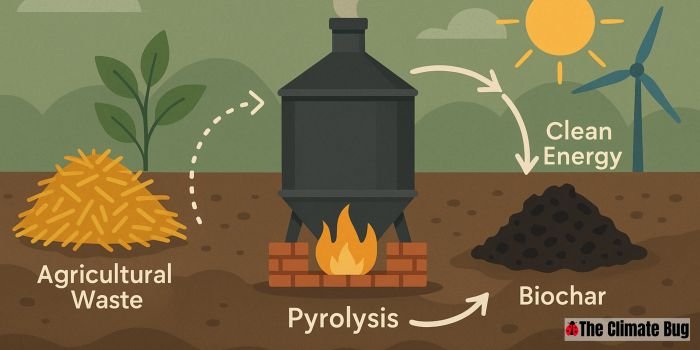

Today, we face two major problems—waste and energy demand. However, researchers now try to solve both at the same time. In this study, Mauro Prestipino shows how pistachio shells can become useful. Instead of treating them as waste, we can turn them into biochar and clean energy. As a result, this idea supports a more sustainable future. It also fits well with the idea of a circular economy.
Material Method
The researchers used pistachio shells as the main material. Then, they applied gasification to convert biomass into gas and solid products.
In addition, they used a pilot-scale system for experiments. At the same time, they built a simulation model to better understand the process.
They tested two conditions. On one hand, one produced more biochar. On the other hand, the second produced more energy. Moreover, they connected the system to a real factory scenario. Therefore, the study becomes more realistic and practical.
Results
The results show strong potential. First, pistachio shells can produce both electricity and heat. The system generated about 574 to 900 MWh per year, which is quite significant.
In addition, the environmental benefits are clear. The system reduced carbon emissions by 241 to 279 tons per year. This means it can help reduce climate change impacts.
However, there is a trade-off. More biochar improves carbon storage. Meanwhile, more energy increases economic returns. Overall, this balance gives flexibility depending on the goal.
Conclusion
This study shows that waste has real value. In fact, pistachio shells can become both energy and useful materials. Therefore, this approach reduces waste and supports sustainability.
Finally, Mauro Prestipino and his team present a practical and scalable solution. In conclusion, their work supports a cleaner future and a circular system where nothing goes to waste.
Reference
Prestipino, M., Famoso, F., Iannitti, L., & Galvagno, A. (2026). From Residual Biomass to Bioenergy and Biochar: A Techno-Economic and Environmental Analysis of Pistachio-Shell Gasification–Cogeneration. Energies, 19, 1306.