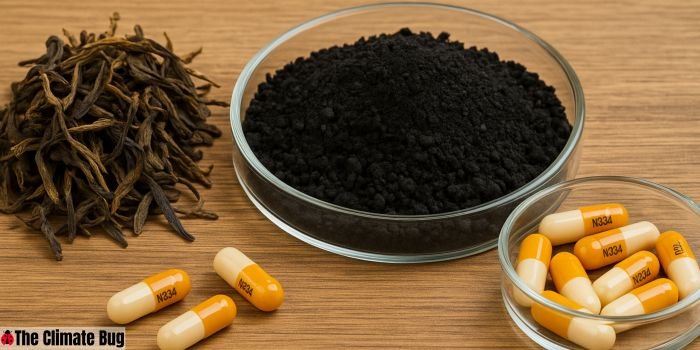

Deepak Das, the first author of this study, tells a very interesting story about how a serious water pollution problem can be solved in a simple and sustainable way. In his research, he explains how antibiotics like chloramphenicol are entering water systems and causing harm to both humans and the environment. These pollutants are difficult to remove and can even lead to antibiotic resistance. To solve this, the researcher developed a special material made from goat waste and advanced chemistry. This idea not only helps clean water but also turns waste into something useful, making it both smart and eco-friendly .
Material Method
In this study, the researchers collected goat manure and carefully cleaned and processed it. Then, they combined it with a special chemical structure called ZIF-67 to create a new biochar composite. This material was heated at high temperature to improve its structure and performance. After that, different experiments were carried out to test how well this material could remove the antibiotic from water. They used tools like FTIR, XRD, SEM, XPS, and BET to understand the material before and after adsorption. They also tested different conditions such as pH, time, and adsorbent amount to find the best performance .
Result
The results of the study were very impressive. The new biochar material removed up to 99.38% of the antibiotic from water, which shows very high efficiency. The material had a large surface area and many pores, which helped trap the pollutant easily. The study also showed that the adsorption process mainly followed pseudo-second-order kinetics and worked best under certain conditions. Even in real tap water, the material performed very well. Although the efficiency reduced slightly after reuse, it still showed good stability for multiple cycles. All these results prove that the developed material is highly effective for water treatment .
Conclusion
Overall, this research shows a powerful and sustainable way to clean polluted water using waste materials. By converting goat manure into a high-performance adsorbent, the study provides a low-cost and eco-friendly solution for removing harmful antibiotics. This approach not only helps protect the environment but also promotes waste recycling. The study opens new possibilities for future research and practical applications in wastewater treatment systems.
Reference
Das, D., Sema, A. I., & Bhattacharyya, J. (2026). Adsorptive removal of chloramphenicol antibiotic from aqueous solutions using functionalised biochar developed from animal-waste. Bioresource Technology.