
In a recent study by Tim Morcom and his team, researchers explored whether biochar can truly improve wheat growth under different conditions. Biochar has been widely discussed as a sustainable solution for soil health, but its real performance in farming systems is still not fully clear. This study focused on testing both raw and enriched biochar, along with different application methods, to see how it affects plant growth from early stages to full crop production.
What the Researchers Did
To understand the full impact, the researchers designed three different experiments. First, they tested seed germination to observe early plant responses. Then, they conducted a greenhouse experiment to measure plant growth under controlled conditions. Finally, they carried out field trials in real agricultural settings.
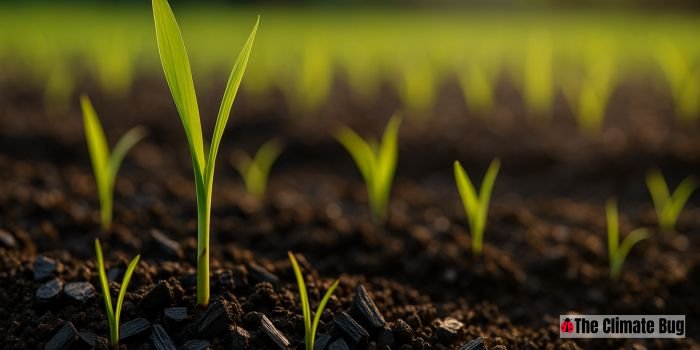
They used wood-based biochar and enriched it with liquid dairy manure and liquid seaweed extract. They also compared two methods of applying biochar: spreading it into the soil and coating it directly onto seeds. This approach allowed them to evaluate both effectiveness and practicality for farmers.
Early Growth Results
The results were quite promising in the early stages. Biochar significantly improved shoot growth, with increases of around 27–29%. In greenhouse conditions, plant biomass increased strongly, with shoot growth nearly doubling in some treatments. These results show that biochar can support early plant development and improve initial crop vigor.
Root and Soil Effects
The study also found that biochar positively influenced root development. Both application methods—broadcast and seed coating—improved root biomass and plant strength. Interestingly, seed coating performed just as well as traditional soil application, suggesting a more efficient and low-cost alternative for farmers.
In terms of soil, biochar showed some interaction with nutrients like calcium, magnesium, and potassium. However, major soil properties such as organic matter and nitrogen did not change significantly in the short term.
Field Performance
When the researchers tested biochar in real field conditions, the results were different. Despite strong early growth, there was no significant increase in crop yield. Environmental factors such as weather conditions, delayed planting, and disease pressure played a major role in limiting the results.
This highlights an important point: what works in controlled environments does not always translate directly to real farming systems
What This Means
This study provides a balanced and realistic view of biochar. It shows that biochar is effective in improving early plant growth, but its impact on yield may take longer to appear or depend on specific environmental conditions.
One of the most interesting findings is the success of biochar seed coating. This method uses less material and could be more practical for farmers, especially in regions where applying large amounts of biochar is not feasible.
Final Thoughts
Overall, this research reminds us that biochar is not a quick solution but a long-term investment in soil health. Its benefits may build over time, especially when combined with good agricultural practices.
Biochar still holds strong potential for sustainable agriculture, particularly in improving soil quality and recycling organic waste. However, more long-term field studies are needed to fully understand how it performs under different conditions.
Reference
Morcom, T., Lumactud, R., Price, G. W., & Jiang, Y. (2026).
Impacts of Raw and Enriched Biochar Applied by Broadcast or Seed Coating on Spring Wheat Growth.
Journal of Sustainable Agriculture and Environment.