
Aug 9, 2025 • For The Climate Bug
Introduction
The clean energy transition is no longer a question of if — it’s a question of how. As the world moves away from fossil fuels, two renewable giants stand at the forefront: solar power and wind power. Both can generate electricity without emitting greenhouse gases, and both can feed directly into the production of green hydrogen, a zero-carbon fuel that many expect to become a backbone of future energy systems.
The challenge for policymakers, businesses, and communities is deciding which technology should take priority now, over the next five years, and into the next decade.
Defining “Better” in Renewable Energy
When we compare solar and wind, “better” isn’t a simple label. It depends on factors such as:
- Cost-effectiveness – Which technology produces cheaper electricity or hydrogen in your location?
- Speed of deployment – How fast can you get it operational?
- Carbon impact – How much CO₂ can be avoided over its lifetime?
- Operational needs – How much maintenance will it require?
- Future readiness – How well does it integrate with hydrogen production, storage, and hybrid systems?
No single technology wins every category in every location.
Solar Energy: Strengths and Weaknesses
Strengths:
- Fast deployment – Installation can take just weeks for rooftop or small ground-mount systems, and months for large farms.
- Low maintenance – With no moving parts, solar requires little servicing.
- Scalability – Works at every scale, from residential to utility-level.
- Urban suitability – Can be installed close to where power is used.
Weaknesses:
- Weather dependent – Output drops during cloudy or rainy days.
- Land requirements – Large-scale installations can take up significant space unless rooftops are used.
- No nighttime output – Requires storage or complementary generation.
Wind Energy: Strengths and Weaknesses
Strengths:
- High energy yield in the right locations – One turbine can produce large amounts of electricity in consistently windy areas.
- Night-time production – Balances solar by generating power when the sun is down.
- Low-cost hydrogen in windy areas – Strong wind resources can make green hydrogen cheaper than solar-powered hydrogen.
Weaknesses:
- Longer project timelines – Turbine siting, permitting, and construction can be slow.
- Higher maintenance needs – Moving parts like blades and gearboxes require regular care.
- Large footprint – Needs space between turbines to operate efficiently.
5-Year Outlook (2025–2030)
In the short term, solar is often the quickest win for adding clean energy. It can be rolled out fast, with relatively low complexity, and begin delivering emission reductions almost immediately.
That said, in regions with strong, steady winds, wind power can outperform solar in producing green hydrogen at lower costs. As electrolyzers — the technology that turns electricity into hydrogen — become more efficient, both solar and wind will see major cost drops for hydrogen production, but wind’s advantage in windy sites could be significant.
10-Year Outlook (2030–2035+)
Looking further ahead, hybrid systems that combine solar and wind will likely dominate. By balancing each other’s strengths — sun during the day, wind at night — they can provide a more consistent power supply and reduce the need for massive battery storage.
After 2035, hydrogen production is expected to grow rapidly, moving into large-scale industrial use, heavy transport, and seasonal storage. Areas investing now in renewable infrastructure that can feed into hydrogen production will be best positioned for both domestic supply and export.
Carbon and Waste: The Climate Connection
Carbon savings:
Both solar and wind replace fossil fuel electricity and prevent CO₂ emissions. The amount of CO₂ avoided depends on how carbon-intensive the displaced power is — the higher the fossil share of your grid, the greater the benefit.
Waste management:
- Solar’s end-of-life panels are increasingly recyclable.
- Wind turbine blades remain a recycling challenge, but new materials and reuse strategies are emerging.
Both produce minimal waste during operation.
Which Should You Choose?
Go solar if:
- You need fast deployment
- You have limited or unreliable wind
- You prefer low-maintenance systems
Go wind if:
- Your location has consistently high wind speeds
- You’re focused on producing hydrogen at scale
- You have space for turbines and maintenance access
Best approach: In many places, combining both solar and wind maximizes clean energy production, supports grid stability, and positions you for a hydrogen-driven future.
Conclusion
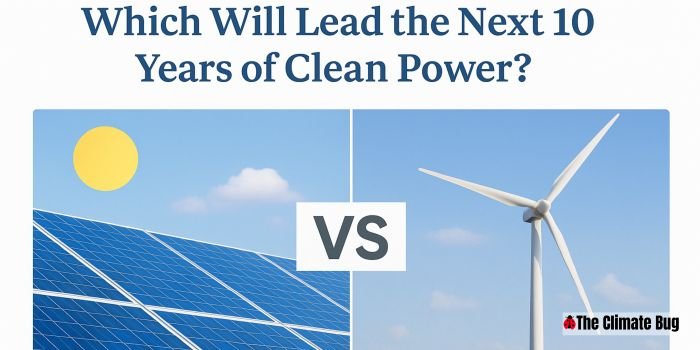
Over the next decade, solar will often lead for speed and accessibility, while wind will dominate in high-resource areas, especially for hydrogen production. Beyond 2035, the focus will shift from competition between the two to collaboration, with hybrid systems delivering clean, reliable energy around the clock.
Reference:
Chowdhury, M. A., et al. (2025). Exploring the potential of solar and wind-powered green hydrogen: Production, costs and environmental impacts in South Asia. International Journal of Hydrogen Energy, 137, 288–302.