The Climate Bug
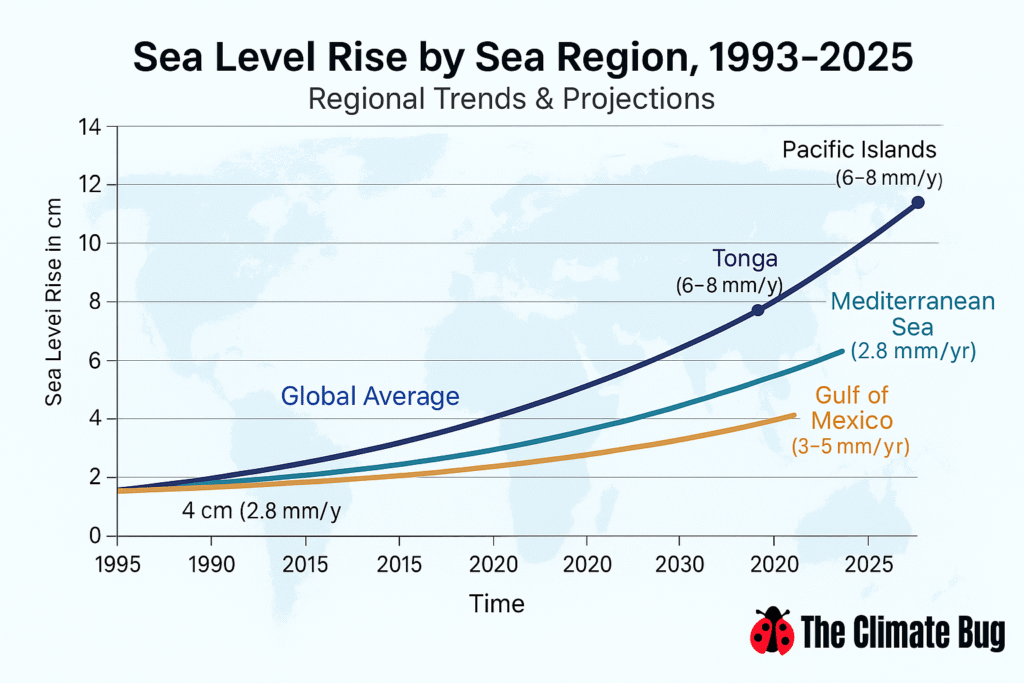
Sea Level Rise Isn’t a Future Problem — It’s Already Here
Every year, the oceans rise — not in theory, but in inches. And the change is not gradual anymore. Since 1993, global sea levels have risen by over 9 cm, with the rate of rise doubling in the past three decades. In 2025, we face a critical question:
Are we ready to live on a planet where the oceans don’t stay in place?
Why Is Sea Level Rising So Fast?
Let’s be clear. Human-driven climate change is the root cause. Based on the most recent research (Suello et al., 2025), here’s what’s behind the rising tides:
- Melting Ice Sheets
- Greenland and Antarctica are losing ice at an unprecedented rate of 427 billion tons per year.
- This meltwater directly flows into oceans, raising sea levels.
- Thermal Expansion
- As ocean water heats up, it expands.
- This alone contributes to about 30-40% of sea level rise globally.
- Groundwater Pumping and Land Subsidence
- In coastal areas like the Dutch Wadden Sea, natural gas extraction has accelerated local sea level rise by up to 9.7–11.7 mm/year — nearly 6 times faster than the global average.
How Fast Is Sea Level Rising?
According to the IPCC and this 2025 study:
| Year | Global Average Sea Level Rise Rate |
|---|---|
| 1980s | 1.4 mm/year |
| 2020 | 3.6 mm/year |
| 2025 | 4.5 mm/year (and rising) |
| Projected 2100 | 8–16 mm/year |
If we don’t act, the sea could rise 0.6 to 1.1 meters (2 to 3.6 feet) by the end of this century — drowning entire island nations, destroying coastal cities, and displacing up to 410 million people globally.
A Surprising Revelation: Salt Marshes Fight Back
A powerful insight from the 2025 study by Suello et al.:
Salt marshes — coastal wetlands found between land and salty water — could be our silent climate warriors.
The researchers discovered:
- In areas with accelerated sea level rise (SLR) (up to 11.7 mm/year), salt marshes double their carbon capture rates.
- Levee zones (within 10m of creeks) saw a 63% increase in organic carbon accumulation.
- Even basin zones (30–40m away) showed a 27% increase in carbon sequestration.
👉 Why This Matters:
Salt marshes don’t just survive sea level rise — they adapt and trap more carbon, slowing climate change.
Countries Most At Risk from Rising Seas
Sea level rise is not equal. Some places will be hit much harder, much sooner.
🌐 Top 10 Most Affected Nations by 2050:
| Country | Population at Risk |
|---|---|
| Bangladesh | 19.6 million |
| Vietnam | 17.1 million |
| India | 36 million |
| China | 43 million |
| Indonesia | 23 million |
| Philippines | 13.6 million |
| Nigeria | 12 million |
| Egypt | 8.5 million |
| Netherlands | 4.3 million |
| USA (Florida, Louisiana) | 6.5 million |
🚨 More than 1 in 10 humans could lose their homes to rising seas this century.
What Can We Do?
Sea level rise is global. But solutions start locally. As citizens, as nations, and as humans, here’s how we take control:
👤 As Individuals:
- Support coastal restoration: Volunteer or donate to salt marsh and mangrove restoration projects.
- Demand climate action from your leaders.
- Switch to clean energy at home.
- Vote for science, truth, and climate justice.
🇺🇳 As Nations:
- Protect natural coastal buffers like marshes and mangroves.
- Fund adaptation infrastructure for vulnerable cities and rural areas.
- Implement carbon pricing and emission cuts.
- Ban fossil fuel subsidies and reinvest in renewables.
What Happens in 10 Years If We Don’t Act?
According to Suello et al. (2025):
- Without major global action, sea level could rise another 4–6 cm by 2035.
- We risk permanently losing 30% of global salt marshes, which are crucial for carbon storage and coastal defense.
- Cities like Jakarta, Miami, and Venice may become uninhabitable without billion-dollar interventions.
- Millions will be forced to migrate — not by choice, but by water.
It’s not 2100 anymore. It’s 2025. And the floodgates are already open.
A Human Wake-Up Call
This isn’t just about ice sheets, tides, or numbers. This is about families, food, homes, and hope.
It’s about the mother in Bangladesh watching her land turn to salt.
The fisherman in the Philippines whose nets come up empty as estuaries collapse.
The child in Miami whose school floods once a month.
And it’s about you. Right now. Reading this.
We are not helpless. We are powerful. And it’s time we act like it.
Final Thoughts — Turn the Tide
Salt marshes are doing their part. They are adapting, sequestering more carbon, and standing between us and disaster. Will we stand with them?
Visit The Climate Bug — stay informed, take action, and be part of the generation that saved the shore.
Reference:
Suello, R. H., Temmerman, D., Bouillon, S., et al. (2025). Increased sea level rise accelerates carbon sequestration in a macro-tidal salt marsh. Science of the Total Environment, 958, 178075. https://doi.org/10.1016/j.scitotenv.2024.178075
- sea level rise 2025
- effects of sea level rise
- salt marsh carbon sequestration
- how to prevent sea level rise
- countries affected by sea level rise
- sea level rise future projections
- coastal flooding
- climate change mitigation solutions
- nature-based climate solutions
- rising sea level action plan