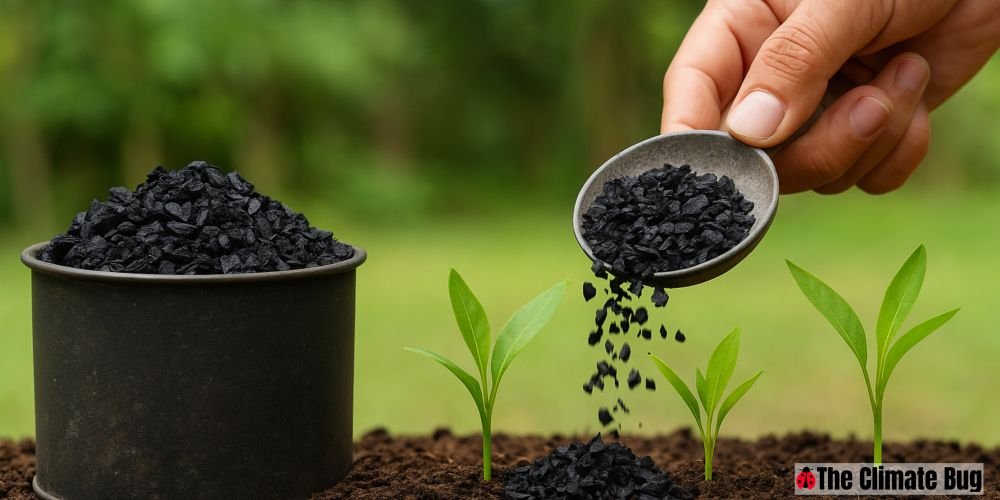

A new study has revealed that biochar made from human waste could play a vital role in solving global fertiliser shortages — while also slashing agricultural emissions and pollution.
What Is Biochar?
Biochar is a charcoal-like substance created by heating organic material at high temperatures in the absence of oxygen — a process known as pyrolysis. When applied to soil, it improves fertility, retains nutrients, and enhances carbon storage. Traditionally produced from crop residues or wood waste, researchers are now exploring human waste as a promising feedstock.
Human Waste: An Untapped Nutrient Resource
The study, published in PNAS and led by Dr Johannes Lehmann, professor of soil biogeochemistry at Cornell University, found that solid human excrement could be converted into nutrient-rich biochar. This could supply up to:
- 7% of the world’s phosphorus,
- 17% of nitrogen, and
- 25% of potassium needs when combined with nutrients recovered from urine.
These three elements — nitrogen (N), phosphorus (P), and potassium (K) — are the main components of synthetic fertilisers. Recovering them from human waste could significantly reduce dependence on mined and industrial sources.
Reducing Waste, Pollution, and Emissions
Conventional sewage sludge used on farms often contains microplastics, heavy metals, PFAS (“forever chemicals”), and pathogens. Biochar production, however, separates waste at the source and eliminates many of these contaminants.
Moreover, the process reduces the weight and volume of waste by up to 90%, making it more efficient to transport and manage. Nutrient levels in the resulting biochar can also be tailored to match specific crop needs, preventing problems like nutrient runoff and eutrophication — the over-fertilisation of waterways that leads to algal blooms and oxygen loss.
A Step Toward a Circular, Sustainable Economy
Dr Lehmann emphasised that recycling human waste into agricultural inputs is about more than soil science.
“The implications go beyond just agriculture and involve economics and geopolitics,” he said. “As finite mineral resources become more scarce, countries without reserves could become dependent on others for their food security. Recycling nutrients through a circular economy can empower nations and promote environmental justice.”
Currently, Morocco controls about 70% of global phosphate reserves, creating geopolitical dependency in fertiliser supply chains. A circular nutrient system could help reduce reliance on finite resources, strengthen local food systems, and mitigate climate-driven migration pressures.
Environmental and Climate Benefits
According to the Intergovernmental Panel on Climate Change (IPCC), agriculture contributes around 25% of global greenhouse gas emissions. A large portion of this comes from fertiliser production and use.
Producing nitrogen fertilisers via the Haber-Bosch process — which converts atmospheric nitrogen into ammonia — and applying them in agriculture emits about 2.6 billion tonnes of CO₂ annually, more than global aviation and shipping combined.
Switching to recycled, low-emission alternatives such as biochar from human waste could help reduce the sector’s carbon footprint and move farming closer to net-zero goals.
Towards a Greener Agricultural Future
Mining phosphate rock leaves permanent scars on landscapes, while potash extraction increases soil salinity and contaminates freshwater systems. Biochar offers a closed-loop solution: recovering nutrients from waste instead of extracting new ones.
As Dr Lehmann notes,
“Talking about sewage isn’t glamorous, but preventing resource wastage through circular economies is crucial to the green transition.”
By viewing waste as a resource, this approach could revolutionise both sustainability and self-sufficiency in global agriculture.
References
Lehmann, J. et al. (2025).Biochar in the circular bionutrient economy https://www.pnas.org/doi/abs/10.1073/pnas.2503668122