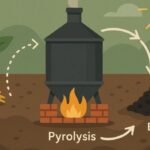

Water pollution is a major problem today. Harmful pollutants like dyes and medicines enter rivers and water systems, causing risks to both humans and nature. In this study, Griffin Loebsack, the first author, explains how biochar can help solve this problem. Biochar made from wood waste can remove harmful organic pollutants from water in a simple and sustainable way.
Material Method
The researchers used Douglas fir and red cedar to make biochar through pyrolysis at 500°C and 800°C under N₂ and CO₂ conditions. They also used treatments like HNO₃, H₂O₂, and KOH to improve the surface properties.
They tested four pollutants: ibuprofen, acetaminophen, methyl orange, and methylene blue. Different tests helped them study how biochar removes these pollutants.
Results
Biochar produced under CO₂ at 800°C showed the best performance. It had a much larger surface area and stronger adsorption ability. The surface area reached 461 m²/g, much higher than biochar made under N₂.
Higher temperature improved aromaticity and surface groups, which helped adsorption. Hydroxyl and carbonyl groups also played important roles in attracting pollutants.
Conclusion
This study shows that biochar is a strong and low-cost solution for water treatment. Better surface area and functional groups improve pollutant removal. Griffin Loebsack and his team proved that waste biomass can become a valuable material for cleaner water and a more sustainable future.
Reference
Loebsack, G., Yeung, K. K.-C., Berruti, F., & Klinghoffer, N. B. (2025). Impact of biochar physical properties on adsorption mechanisms for removal of aromatic aqueous contaminants in water. Biomass and Bioenergy, 194, 107617.