
Some pork from uncastrated male pigs gives off an unpleasant smell when cooked, known as boar taint. It is caused mainly by androstenone, a steroid that builds up in the animal’s fat. The usual way to prevent it is to castrate male piglets, often without pain relief, which raises serious animal-welfare concerns and is being phased out or restricted in some countries. Farmers need alternatives.
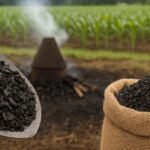
Earlier research found that feeding pigs biochar, a charcoal-like adsorbent, can reduce androstenone in their fat. A 2026 study in the Journal of Animal Science by Melissa Parent, Christine Bone, Lee-Anne Huber and E. James Squires looked at why some pigs respond to this treatment and others don’t.
Study at a glance
- Type: feeding trial with boars from two commercial genetic lines
- Treatment: 5% biochar in the diet for four weeks, then a two-week recovery period without it
- Measured: androstenone in blood and fat, a steroid marker (estrone sulfate), and growth
- Source: Parent et al. (2026), Journal of Animal Science 104, skaf463
What the researchers did
Boars from two genetic lines, from Alliance Genetics Canada (AGC) and the Pig Improvement Company (PIC), were all fed a diet containing 5% biochar for four weeks, starting at about 75 kg body weight and 111 days of age. Biochar was then removed for two weeks. The team measured androstenone in blood weekly and in fat every two weeks, and tracked growth.
To see whether the pigs’ own hormone production mattered, they also measured estrone sulfate (E1S) in the blood at about 130 kg. Boars with more than 16 ng/mL were classed as having high “steroidogenic capacity” (producing more steroid hormones); the rest as low.
What they found
- Many boars never developed taint. Fat androstenone stayed below the 1 µg/g threshold throughout the trial in 71% of PIC boars and 47% of AGC boars.
- Most of the rest responded. Among boars capable of developing boar taint, 89% of AGC boars and 67% of PIC boars responded to the biochar treatment.
- Non-responders shared one trait. Boars that did not respond to biochar were all in the high steroidogenic capacity group. Responders, and boars that never developed taint, included both high and low groups.
- Little difference between lines. Androstenone levels did not differ between the two genetic lines, and growth was similar except that PIC boars had better feed efficiency during treatment and faster growth during recovery.
What to keep in mind
- No untreated comparison group. All boars received biochar. The study compares genetic lines and hormone groups, so it cannot by itself show how much biochar reduced androstenone compared with no treatment, or whether it affected growth.
- Not a universal fix. A sizeable share of capable boars, especially in the PIC line, did not respond.
- Prediction needs more work. The authors say additional research is needed to find genetic and biological markers that reliably predict which animals will benefit.
Why it matters
If boar taint can be controlled through diet, more farmers could raise uncastrated males and avoid a painful procedure. This study suggests that a pig’s steroid hormone production could help predict whether biochar feeding will work, which could eventually allow the treatment to be targeted at the animals most likely to benefit.
Reference
Parent, M., Bone, C., Huber, L.-A., & Squires, E. J. (2026). Effect of genetic line and steroidogenic capacity on response to dietary supplementation of biochar to control fat androstenone levels in boars. Journal of Animal Science, 104, skaf463. https://doi.org/10.1093/jas/skaf463