
In a recent perspective paper by David Chiaramonti and colleagues (2024) , one of the most promising tools in climate mitigation is explored—biochar as a long-term carbon removal strategy.
More Than Just a Soil Amendment
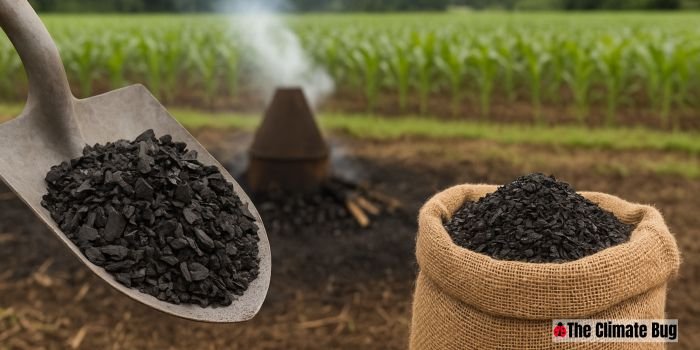
What the authors clearly demonstrate is that biochar is not just another soil amendment. Instead, it represents a scientifically validated carbon dioxide removal (CDR) technology capable of storing carbon for hundreds to thousands of years. Through the process of pyrolysis, biomass is converted into a highly stable carbon form, which resists microbial decomposition and remains locked in soils over long time scales.
Understanding Carbon Permanence
The paper focuses strongly on carbon permanence, which is one of the biggest challenges in climate solutions today. The authors explain that biochar contains different carbon fractions, but a significant portion forms highly condensed aromatic structures—similar to naturally occurring inert carbon in geological systems. This makes biochar a reliable and durable carbon sink, supported by both experimental evidence and long-term field observations.
Measuring and Verifying Carbon Storage
Another key contribution of this study is highlighting how biochar carbon removal can be measured, verified, and certified. The authors discuss practical analytical approaches such as H/C ratios and reflectance analysis, which allow researchers and policymakers to quantify how much carbon is truly stable. This is critical for integrating biochar into carbon markets and national climate targets.
Environmental and Agricultural Co-Benefits
Beyond carbon storage, the paper emphasizes the multiple co-benefits of biochar. These include improving soil health, enhancing water retention, supporting microbial activity, and increasing agricultural resilience under climate stress. In this way, biochar stands out from many other CDR technologies by combining climate mitigation with sustainable agriculture.
Final Insight
Overall, Chiaramonti et al. present biochar as a ready-to-deploy, scalable, and cost-effective solution with high technological maturity. Their work reinforces the idea that achieving net-zero—and even net-negative emissions—will require integrating nature-based solutions like biochar into global climate strategies.
Reference:
Chiaramonti D., Lehmann J., Berruti F., Giudicianni P., Sanei H., Masek O. Biochar is a long-lived form of carbon removal, making evidence-based CDR projects possible[J]. Biochar, 2024, 6: 81. DOI: 10.1007/s42773-024-00366-7.